

Choosing an IB Math tutor can be more complicated than simply finding someone who is good at mathematics. IB Mathematics has different courses, levels and assessment requirements, and students can struggle for very different reasons. Some may have gaps in prerequisite knowledge, while others understand the mathematics but find the examination style, Internal Assessment or time pressure more difficult.
For parents in Hong Kong, the most suitable tutor is therefore not necessarily the person with the strongest mathematics qualifications alone. It is also important to consider whether the tutor understands the IB curriculum, can identify the student’s specific difficulties and can provide structured support throughout the course.
1. Make sure the tutor understands AA and AI
IB Mathematics is divided into two main courses: Analysis and Approaches (AA) and Applications and Interpretation (AI). Each course is also offered at Standard Level and Higher Level.
Although there is overlap between the courses, their emphasis is different. AA generally places greater emphasis on algebraic techniques, mathematical reasoning and analytical methods, while AI gives more attention to applications, modelling, statistics and the use of technology.
A tutor should therefore know exactly which course and level the student is taking. Teaching an AA HL student in the same way as an AI SL student is unlikely to be effective. The topics, level of depth and style of questions can differ considerably.
Parents may therefore want to ask whether a tutor regularly teaches both AA and AI and whether they are familiar with the differences between SL and HL.
2. Check whether the tutor understands the IB examination style
Knowing the mathematics is only one part of preparing for IB Mathematics examinations.
Students also need to become familiar with the way questions are structured, how marks are awarded and how much working should be shown. They need to learn when calculator use is appropriate, how to interpret command terms and how to manage time across a paper.
Past papers can be very useful, but simply completing large numbers of questions is not always the best approach. A tutor should be able to identify patterns in the student’s mistakes and decide whether the problem comes from mathematical understanding, exam technique or lack of familiarity with certain types of questions.
As the examination approaches, a structured past-paper programme can help students become more confident and efficient.
3. Look beyond exam preparation
A student who performs poorly in IB Mathematics does not always have an “IB problem”.
Sometimes the difficulty is caused by an earlier gap in algebra, fractions, functions, trigonometry or another prerequisite topic. In other cases, the student may understand the mathematics but struggle to interpret unfamiliar questions or organise a solution clearly.
A useful tutor should therefore diagnose the cause of the difficulty rather than immediately assigning more practice questions.
For example, if a student repeatedly struggles with calculus questions, the underlying problem may actually be weak algebraic manipulation. Repeating calculus exercises without addressing the algebra may not solve the problem.
This diagnostic process is particularly important when a student has recently changed schools or moved between different curricula.
4. Ask about experience with the Internal Assessment
The Internal Assessment is an important part of IB Mathematics, and students often find it very different from ordinary classroom exercises.
A good IA should involve mathematics that the student understands and can explain. The topic should also be practical enough to develop into a complete investigation.
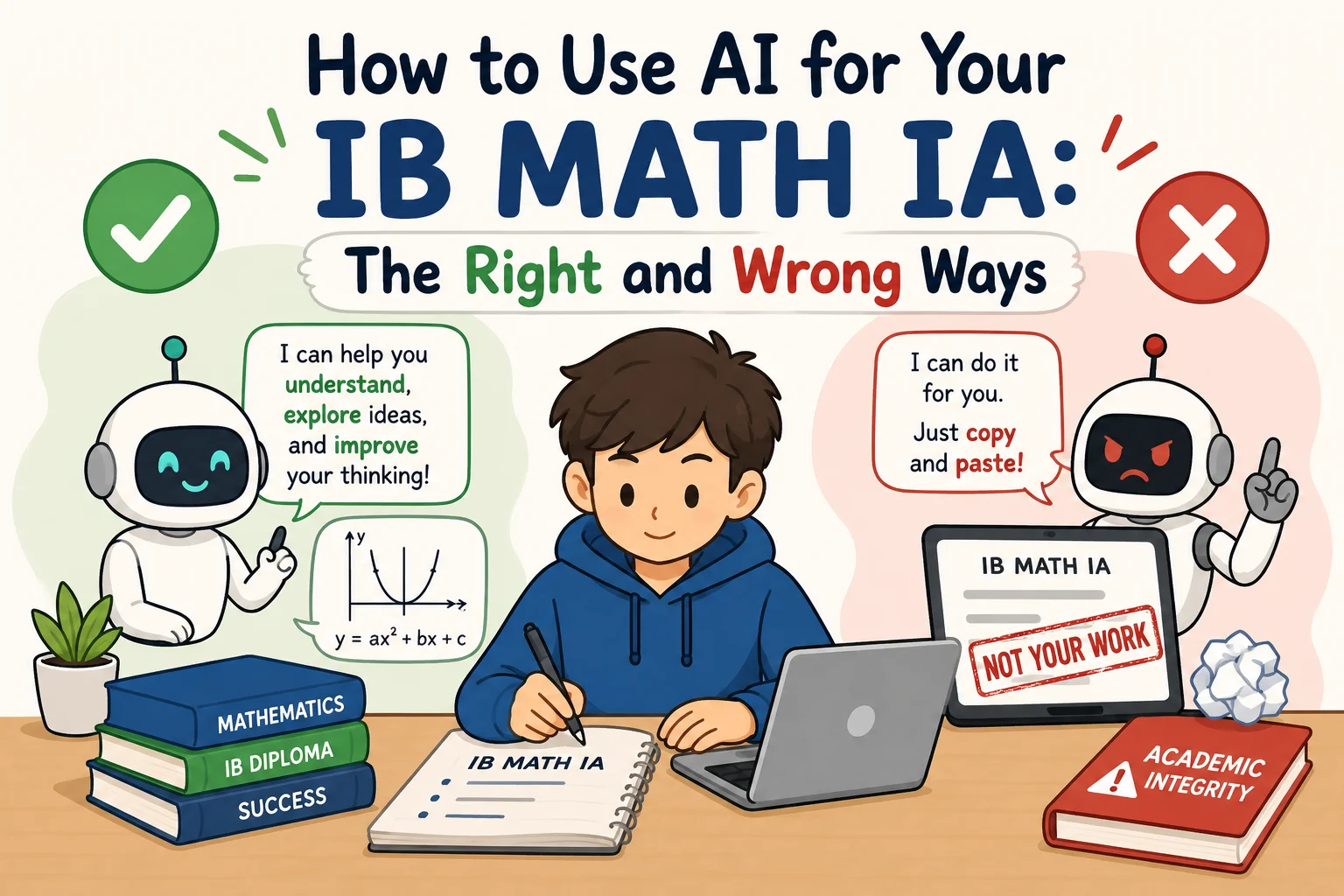
Support with the IA should not mean writing the project for the student. Instead, a tutor can help the student evaluate whether an idea is mathematically feasible, understand the methods being used and identify weaknesses in the structure or reasoning.
This is especially important now that students have easy access to AI tools. Producing complicated mathematics is not useful if the student cannot explain what the calculations mean.
Parents may therefore want to ask how a tutor approaches IA support and how they ensure that the student remains responsible for the work.
5. Consider whether the tutor can identify gaps from earlier curricula
Hong Kong international-school students often move between different educational systems.
A student may come into IB Mathematics from IGCSE, GCSE, a local curriculum, an American curriculum or another international programme. Although these systems cover many similar topics, the timing and depth of particular skills can vary.
As a result, a student can appear to struggle with IB Mathematics when the real issue is that an assumed prerequisite was never fully developed.
A tutor with experience across different curricula may be better able to recognise these gaps and rebuild the required foundations before moving on.
This is particularly useful for students who have recently changed schools or moved between countries.
6. Look at how lessons are structured
Parents should also consider how the tutor organises lessons.
Effective tutoring should not consist entirely of answering whichever homework question the student brings to the lesson. There should normally be some structure based on the student’s current schoolwork, weaknesses and upcoming assessments.
Depending on the stage of the course, this may include topic revision, targeted exercises, past-paper work, IA guidance or preparation for school tests.
It can also be useful for parents to know whether the tutor provides feedback on progress and whether there is a clear plan for the coming weeks.
The exact structure does not need to be rigid, but there should be a clear reason behind what is being studied.
7. Online or face-to-face tutoring
Both online and face-to-face tutoring can work well for IB Mathematics.
Online lessons can offer greater flexibility, particularly for students with busy school schedules or those living in different countries. They also allow students to work with a tutor who specialises in their exact course rather than being limited by location.
Screen sharing, digital writing tools and online resources can also make mathematics lessons effective when used properly.
However, the most important factor is not the format itself. The quality of explanation, lesson structure and communication between tutor and student matters much more than whether the lesson takes place online or in person.
8. Questions parents can ask before choosing a tutor
Before starting lessons, parents may find it useful to ask a few practical questions:
- Which IB Mathematics courses and levels do you teach?
- Do you teach both AA and AI?
- How do you identify gaps in a student’s mathematical knowledge?
- How do you use past papers during the course?
- How do you support students with their Internal Assessment?
- How do you track progress?
- How do you adapt lessons when a student has moved from another curriculum?
The answers can give a much clearer picture of the tutor’s approach than qualifications alone.
Conclusion
Choosing an IB Math tutor is not simply about finding someone who can solve difficult mathematics problems. The tutor should understand the structure of the IB course, recognise the differences between AA and AI, identify gaps in the student’s knowledge and help the student develop both mathematical understanding and examination technique.
For students who need structured support in IB Mathematics, you can learn more about my IB Math tutoring in Hong Kong, including support for AA, AI, SL and HL students.
Frequently Asked Questions
What should I look for in an IB Math tutor?
Look for experience with the specific IB course and level, familiarity with AA and AI, exam preparation, Internal Assessment support and the ability to identify gaps in prerequisite knowledge.
Is online IB Math tutoring effective?
Yes. Online tutoring can work well when lessons are structured properly and use screen sharing, digital writing tools and suitable resources.
When should a student start IB Math tutoring?
It depends on the student. Some begin when they encounter difficulties, while others start earlier for structured syllabus support, IA preparation or exam practice.
Can an IB Math tutor help with the IA?
A tutor can help a student understand the mathematics, evaluate whether an investigation is feasible and improve the structure and reasoning. The student should still complete and understand the work themselves.